


By @IanMount and @AdrianBono | February 22, 2024 | Madrid | Issue #45
🎉 Welcome to The Tapa, an English-language, weekly newsletter about all things Spain!
🥜 This Week in a Nutshell: There was no big surprise Sunday after the Galicia regional elections. The Partido Popular got enough votes to remain in power and the PSOE saw dismal results as many people chose the nationalist party BNG instead.
🙏 Remember that if this email gets truncated at the bottom because it’s too long, just click here to read the rest on Substack.
🙌 One more thing: We are offering paid subscriptions, and we’d be thrilled if you purchased one to help build this enterprise we’ve had so much fun creating. (And to those of you who have already subscribed, thanks for the love 🥰.)
🕺If you haven’t subscribed yet, please do so by clicking on the button below.
🫶 And if you already have, please send this newsletter around to your friends and family and help us keep growing.
Good news for Feijóo
🔵 Galicia Regional Elections: PP Remains in Power
The center-right Partido Popular (PP) finally caught a break this past Sunday in the Galicia regional elections, after a few complicated weeks for the conservatives.
While some polls predicted that a leftist coalition between nationalist BNG and the PSdeG (center-left PSOE’s local arm) could pull off an upset, the PP came out on top in the end and then ran around like they’d won a Nobel Prize.
This election marked a continuation of the PP’s dominance in Galicia, a stronghold where they've maintained a majority for most of the past 34 years.
The PP and PSOE’s leaders have both been on their heels recently (more below), so the election was seen as a referendum on both PP boss Alberto Núñez Feijóo and the PSOE leader (and Prime Minister) Pedro Sánchez.
How do we know it was seen as a referendum? National political leaders campaigned heavily alongside the regional candidates in Galicia’s four provinces.
So who are this election’s big winners and losers? Let’s take a look!
Big Winners:
The Partido Popular. The PP stays in power after obtaining 40 seats out of 75 in the regional Parliament. While they lost two seats with respect to the 2020 election, they still got 47.36% of the vote (700.491 people) and a majority, and their current regional head Alfonso Rueda will get four more years.
Alberto Núñez Feijóo: This victory not only shows the PP's power in the region but also saves the hide of party boss Feijóo—a former Galicia president himself. After the damage caused by recent revelations that he had considered offering pardons or amnesty to Catalan separatist leaders if they helped him form a PP-led government, pundits claimed that a loss in Galicia could cost Feijóo the party leadership. But the results confirmed him as boss, an interpretation Feijóo, um, leaned into: “If they wanted this to be a plebiscite on my leadership, here is the result.”
Really, Feijóo was feeling cocky. On Wednesday, he and Sánchez clashed in Parliament and the PP leader was clearly emboldened by the results. “Here I am, on my feet,” he told Sánchez, “after a 40-9 result” (yes, it was a bad night for the socialists, more on that below).
Sánchez counterattacked by bringing up the scandal over the considered Catalan pardons, but Feijóo was having none of it. “You outdo yourself everyday,” he replied. “You started by lying about what I do, you continue lying about what I say, and now you lie about what I think. When it comes to lies, you win by a landslide.” Daaaaaaaaamn 🔥.
Winners:
The Bloque Nacionalista Gallego (Galician Nationalist Bloc or BNG): These guys came in second. So no 🏅. However, they had a fantastic election as they managed to secure 25 seats (six more than in 2020) — their best election results ever. The election solidifies the party as a major political force in the region (with 31.57% of the vote, or 467.074 voters), advocating a left-wing Galician nationalism.
Democracia Ourensana: “Who?”, you’re probably asking. Don’t worry, most people don’t know them either but these Ourense localists managed to win one seat (1.03% of the votes) so they deserve a shout out. Did the party get a big push from this viral video featuring Ourense mayor singing to the tunes of YMCA? Ab-so-lute-ly. Are they irrelevant? Yes. Are they happy? Also yes.
Losers:
PSdeG, PSOE and Prime Minister Pedro Sánchez: Yikes. It was a dismal night for the socialists. In fact, they only managed to hold nine seats out of the 14 they won four years ago (they got 14.04% of the vote, or 207.691 votes), a historic low for the party’s Galician branch (PSdeG) led by José Ramón Gómez Besteiro.
Was this a rejection of Sánchez’s plans to offer blanket amnesty to Catalan separatists facing legal troubles over the whole trying to break up with Spain thing? Well, it depends on who you ask.
The PSOE insists these elections were strictly regional and actually they lost because voters didn’t know their candidate. (Though people here vote straight party tickets.) Speaking to the press yesterday, Sánchez even said that the results were “in no way” related to the endless negotiations with Catalan separatist party Junts. Translation: These are not the droids you’re looking for.
But really? Socialist leaders are reportedly saying they are “exhausted” and “worried” that the amnesty debate is hurting the party, according to El Mundo.
That sounds more honest: “These are bad results, there’s no sugarcoating them,” said socialist A Coruña mayor Inés Rey.
Big losers
Last and definitely least, we have the big losers: Sumar, Podemos and Vox.
Sumar and Yolanda Díaz: This one must have hurt, as the leader of the lefty party, Second Deputy Prime Minister Díaz, is Galician (aka gallega). Despite Díaz’s efforts to hoist her candidate, Marta Lois, the party performed abysmally in its regional debut, notching up a meager 1.9% of the vote and no seats.
Podemos: Far-left Podemos saw even worse results, obtaining only 0.26% of the vote—fewer votes than animal rights party PACMA. Was there self-criticism from the party’s national leadership and talk about joining with Sumar? Nope.
Vox: The tighty righties failed once again to gain traction in Galicia and remain unable to steal a significant amount of votes from the PP. Vox fell short of entering the Galician Parliament (they only got 2.19% of the vote), just like in 2020
Next stop: Basque Country regional elections in the spring. Grab your popcorn🍿.
🔔 A Message From Our Sponsor — With a Coupon!

MEAT MADRID is your carnivorous stomach’s home away from home in Spain’s capital. Seriously, look at the name. And we’ve got an offer to prove it.
Hungover? Not yet? Come celebrate making it through Dry January with Wet February at MEAT. Tell your waiter you're with The Tapa or show him this coupon on your phone for two free drinks (beer, wine or soft drinks) with your meal (€15 min. check/diner). Valid through February.
MEAT is located on Calle de Santa Teresa 4, just off Plaza Santa Bárbara, and open every day from 13-16:30 and 19:30 to midnight. Reservations: 91 029 60 41.
Follow Meat Madrid on Instagram.
💬 Five things to discuss at dinner parties this week
1. 🇷🇺 That Russian pilot defector found dead in Alicante
One Spain story made the international headlines this week because it involved Russia and mysterious deaths. Maxim Kuzminov, the Russian pilot who made the news after defecting to Ukraine last year, was found murdered in Alicante last week, and signs point to a hit planned by Russian intelligence.
Kuzminov's defection was a big deal. He landed a Russian Mi8 military helicopter in Ukrainian territory and turned himself in, in a carefully planned defection and theft the Ukrainian authorities dubbed “Operation Synytsia.”
Ukrainian authorities said they offered protection and financial incentives to encourage Kuzminov to remain in Ukraine, but je chose to use his money (the Ukrainian government gave him $500,000) to move to the Spanish coast under a false name (Ukraine provided official documents for his new identity). Spanish intelligence was apparently never notified of this.
What we know. Kuzminov was found dead on Feb. 13 in a parking garage in Villajoyosa, Alicante. His body was riddled with bullets (he was shot five times) and had been run over by a car that was later found burned outside a nearby city. His identity was confirmed by Ukrainian intelligence.
Moscow’s foreign intelligence chief Sergei Naryshkin condemned his defection after learning of his death and said: “This traitor and criminal became a moral corpse at the very moment he planned his dirty and terrible crime”.
Not what it seemed. While initially thought to be a gang-on-gang crime, investigators soon realized that his papers were fake and that it was indeed Kuzminov, which caught the attention of the international media, especially coming only a few days after Putin critic Alexei Navalny died in prison.
Spanish intelligence services have no doubt that the Kremlin is behind his death but so far no much more is coming out of the government. (They still may be miffed at not being warned of his presence.🤔)
Kuzminov was “imprudent” and “well known” by the local police, ABC reports, because he had been involved in “altercations”. The publication also mentions drug use, prostitutes, but take that with a grain of sal as that is, coincidentally, what Russian media said was responsible for his death.
Not the best choice of lcoale: Kuzminov picked a preferred destination for Russian and Ukrainian citizens, so he was probably “identified quickly”. Local authorities call moving to Alicante a mistake, as it’s the Spanish province with the largest number of Russian citizens (17.500).
Kuzminov had apparently called Russia to “invite his girlfriend over”, El Español also reported, which may have helped Moscow pinpoint his location.
What we don’t know. The focus is now on who killed him, although it’s unlikely they are still in the country.
Spanish intelligence services admit that it’s “very difficult” to find evidence of those involved. They assume that the crime was committed by gunmen hired by Moscow who came from outside of Spain and by now are probably back abroad.
2. 🚜 Tractors, cows, vertigo and fascists—we got it all!
Nobody told Luis Planas that being Spain’s minister of agriculture was going to be so tough. But this week, oh it was! Thousands of farmers riding hundreds of tractors invaded the center of Madrid (honestly, this was sorta fun) to demand more government aid, for one thing.
Vertigo: Oh, and Planas almost passed out while speaking in parliament Wednesday, collapsing to his seat before claiming that it was nothing but a wee touch of vertigo.
But back to the cause of this all: the farmers. Spain’s farmers have been cheesed off for a while now (as we wrote two weeks ago), and to express this cheesed-ness they’ve been organizing tractoradas (you know, blocking roads and stuff with tractors) at various highway chokepoints—and in various cities—across Spain. Country mouse, meet city mouse!
Why? The usual: 💰, or the lack thereof. It’s been a crap time to be an EU farmer, as inflation has increased supermarket prices but not always what the farmers get, and as stringent green regulations make farming more expensive. So… tractorada (or tractorazo, depending on your style).
No money, no farm: “It is impossible to live from the rural industry, which is what we want, to live from our work. That is all we ask for,” Silvia Ruiz, 46, a livestock farmer from Burgos told the AP.
Country José comes to Madrid. Wednesday was the big culmination of weeks of farmer protests, and that means bringing the show to the capital—Madrid.
Some 13,000 came to town, according to the farmers' union (the government said 4,000 because no one can agree on numbers any more). They all agree that 500 tractors came into the city, so at least we have that.
Visiting the sites. The farmers circled around the Puerta de Alcalá (where they grazed cows!) and protested outside Planas’ Ministry of Agriculture. Some even made it to the Plaza de Cibeles (maybe because that’s where Real Madrid celebrate their trophies? It’s also city hall, of course).
But not funny. Some protestors shoved and pushed a TV news crew from LaSexta outside the ag ministry, telling them to “get out” and calling them “manipulators” (LaSexta is a left-leaning channel and many of the farm groups are more to the right). LaSexta anchor Antonio García Ferreras then called them “unpresentable, mad, pitiful characters” and “fascists” which is like the way all arguments end these days.
So can you really criticize Planas for feeling a bit of vertigo? We can’t.
3. 🏆 Madrid: City of the Rich, by the Rich, for the Rich
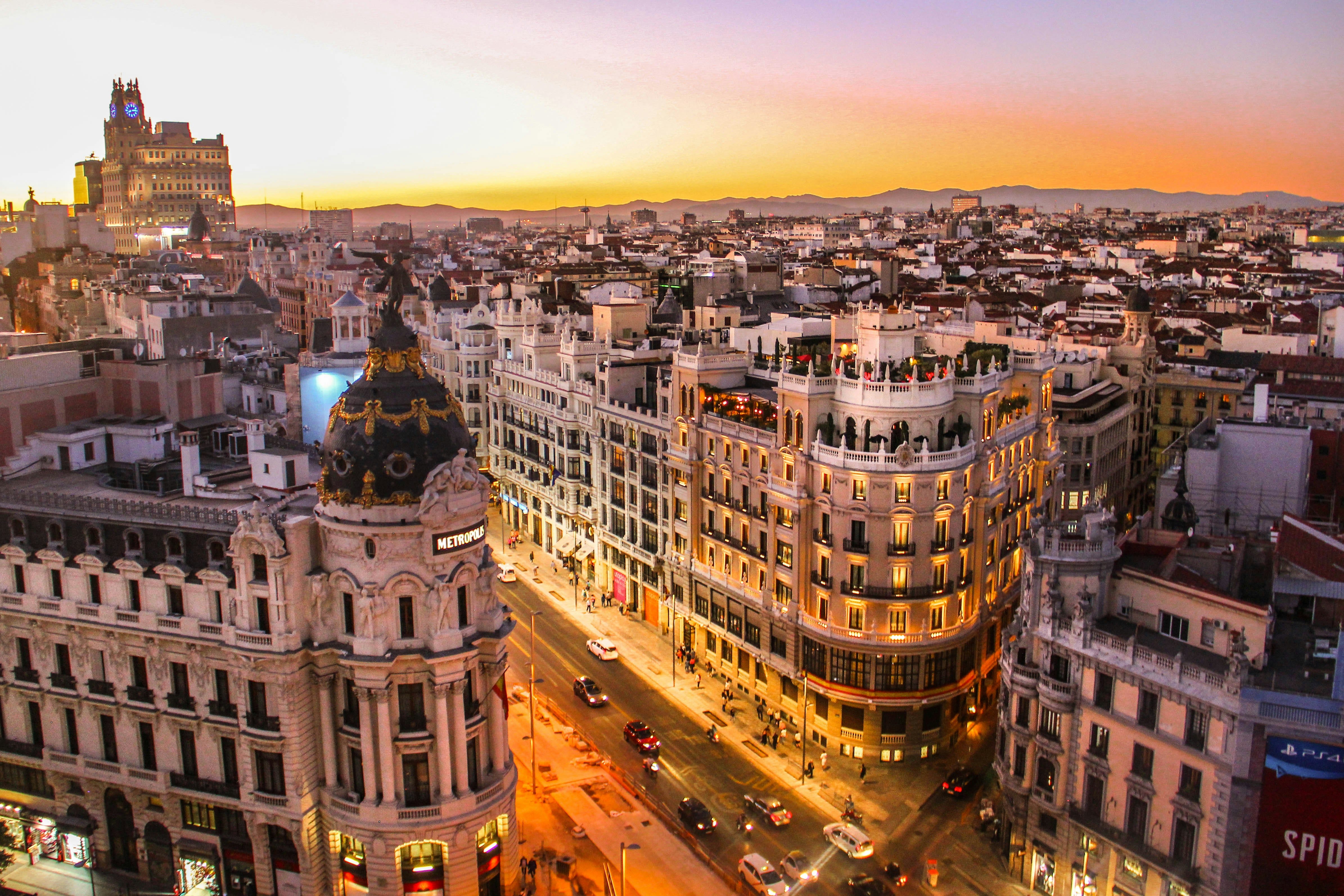
Madrid locals don’t need to be told how much it’s changed in recent years. The luxury café:resident ratio has reached Brooklyn levels (i.e. 1:1); the Urbanite’s Wail of Woe at the closure of mom-and-pop shops that we liked in theory but never actually visited has been named the city’s official Eurovision entry; and the 3-star resto of “World’s Best Chef” (three times running!) DavidDabiz Muñoz, DiverXO, has gotten sooooo swanky it’s moving inside a gated community so you will no longer be able to even look at it wistfully.
But if we needed proof, we have it! Lujo realtor Barnes published its annual Global Property Handbook and there’s Madrid right there, in fourth place among the cities most popular among High Net Worth Individuals (HNWI, aka uber rich F&$*ers).
That’s up five places from last year. Madrid sits behind top dog Dubai, Miami and New York. And (more importantly, because fourth is…fourth), ahead of Paris (5), Barcelona (19) and Málaga (47). 😂
We all know why Madrid is great, but it’s fun to hear it in HNWI-speak. It is, for example, “Cosmopolitan, festive and bustling”, which is true.
And, like, it seems people don’t work so much. “Traditionally, the work-life balance has been admirable for Madrid’s residents given the importance placed on time spent on leisure activities, culture and entertainment.” 🥂
But we know what this means, right? Yup, it’s getting mad unaffordable. According to the Barnes Handbook, €1m will buy a HNWI a 80m2 place in Salamanca, where ye olde “high-end” apartments go for €11,000 a square meter.
Blame the foreigners. South Americans account for 60% of foreign luxury property buyers (see Salamanca 👆) while—and we literally quote—the high-end rental market is underpinned by international students with high rent budgets “often upwards of €10,000 per month.” 😱
…and the bankers. “There are many venture capital firms and investment banks that were not present in the city and now are,” Alvise Da Mosto, managing director of Barnes Madrid, told Cinco Días. “This allows senior leaders who have their residence in London or Paris to begin to evaluate the possibility of buying a home in Madrid with an eye to living here full-time.”
As they say, here comes the neighborhood.
4. 🦆 Madrid’s mascletá and the “patofake”
Madrid’s mascletá was born from a bet. Madrid mayor José Luis Martínez-Almeida told his fellow PP member María José Catalá that if she won Valencia’s mayoralty in last May’s local elections, he would bring Valencia’s famous mascletá to Madrid. And she won.
Wait, what’s mascletá? It’s a massive daily pyrotechnic event in Valencia’s Fallas, an annual festival in March where participants blow up a lot of stuff and make giant satirical floats mocking politicians and other famous folk (which they then blow up). It is fun and loud and involves a) fireworks, b) alcohol and c) churros. Which is good.
But we can’t just have get together and agree to have an event. In today’s Spain, anything people with opposing political views do is bad bad bad. Plus, fireworks are loud. So after Madrid city hall kept specifics of the event quiet until the last moment, neighborhood and environmental groups complained that the fireworks would be bad for locals and pets and really bad for the birds that live in and above the planned mascletá site—the Río Manzanares area near the royal palace.
Salvando Peludos, one of those groups, even sued, noting the event was taking place in a protected natural zone, and claimed it would “cause a massacre among the fauna". You can sorta see that blowing up a lot of gunpowder next to a river wouldn’t be ideal for creatures big and small. Right? At the same time, blowing up stuff is fun! We are torn. But a Madrid judge was not, and shot down the request to stop the event.
The event was, you guessed it, loud. It lasted 7 minutes, used 300 kilos of gunpowder, and involved lots of colored fireworks stripes like the Spanish and Valencian flags, and came in waves of increasing volume that made you dance. Like, forced motion..
Lot of people came. But how many? The local rep of the national government (which is run by the rival PSOE) said 20,000. Twitterati who don’t like the PP posted photos taken a while before the event, showing holes in the crowd, and said it was a total bust.
The Tapa was present at the mascletá and can say it felt like a lot of people were there, but we have no idea how to count crowds, so we’re totally not getting into this.
But then things really got fun! Just when we thought this would be a typical low.-grade political spat, a city council member with the left-wing Más Madrid (i.e. not a PP friend) posted on X a picture of a dead duck at the site of the mascletá with the slogan “Thanks Almeida.”
Next, intrigue! A local resident then gave Telemadrid (local TV, overseen by the PP government) a WhatApp video of a little girl pointing to the dead duck timestamped three minutes before the mascletá started.
Other Twitterati (like the Más Madrid rep) then pointed out that several warning fireworks were sent up before the official start—including one two minutes before the timestamp—so maybe that killed the duck. So when did it die? Somebody needs to timestamp the death, or…
The PP city councilman in charge of the environment asked Más Madrid if it intended to perform an autopsy on the duck, Almeida asked the “bitter and sad” left to apologize for creating controversy around the “patofake” (fake duck) and Más Madrid city leader Rita Maestre in reply asked the PP not to make a fool of itself.
We know it was meant as a joke, but we want an autopsy. Or at least for pato(fake?) to be plucked and prepared Peking style. Is that too much to ask?
5. 👶 No Baby No Cry

Any statistical comparison that ends with “since the Civil War” is generally bad. And this one is (unless you don’t like babies—then it’s fantastic).
The stat at hand is Spain’s birth rate. 322,075 of the little human critters were born in Spain last year, which is…the lowest since national stats agency INE began keeping records in 1941.
Let’s think about the babies. That means there were fewer babies born than just after the end of Spain’s Civil War, when the country’s population was 26m—or about 22m fewer than today. We’re not professional demographers here at The Tapa, but that seems like non-positive news.
So…why? Spain’s birth numbers have been doing a swan dive since 2014, when they hit 426,076. To put that in a percentage, they’re down 24.1% since 2013. Zoinks! Does that mean Spain will, like, just wink out at some point?
If you were just thinking of current citizens, yes. Organic population growth has been negative in Spain every year since 2017 (“Negative growth”? Gotta love statistics). Last year, the change—measured in births minus deaths—was -113,256. Of Spain’s comunidades, only Madrid, Murcia, Baleares, Ceuta and Melilla recorded organic population growth in 2023.
But, but, but… Spain’s population is at a record of 48.6m. How? That number includes 6.5m foreigners. Immigrants (and their babies) are keeping Spain’s head (or at least its population) above water.
This naturally leads to the question of ‘why’. For one thing, people in Spain are having fewer kids and having them later, much like all over the world; 10,7% of babies born in Spain last year were to women 40 and up, compared to 6.8% 10 years before.
But Spain’s also got that special housing thing. As we wrote last month, Spain’s average age of “emancipation” (i.e. leaving mom and dad’s house) is just over 30, compared to the European average of 26.4 years. Because the real estate market is so crazy expensive people can’t afford to leave (see Madrid’s rich property buyers 👆).
So stop complaining about the immigrants (this means you, Vox). And pour out a caña for the youths: living with parents ≠ good atmosphere for having baby.
🙏 Before you go, please remember to share this newsletter with your friends on social media. The more we grow, the more information we’ll be able to offer each week.
Nice post guys🙌🏻