


By @IanMount and @AdrianBono | June 22, 2023 | Madrid | Issue #19
🎉 Welcome to The Tapa, an English-language, weekly newsletter about all things Spain!
🥜 This Week in a Nutshell: It’s been a tough few days for the Partido Popular (PP) as Vox, the far-right party that they will likely need to form a government if they win the 23J elections, has been in the news for showing its less-than-lovable side. In the meantime, PP leader Núñez Feijóo is tip toeing around it, trying to defend—but at the same time criticize—Vox’s combative rhetoric. Fasten your seatbelts, people! Today’s newsletter is all about the far-right.
🙏 Remember that if this email gets truncated at the bottom because it’s too long, just click here to read the rest on Substack.
🕺If you haven’t subscribed yet, please do so by clicking on the button below.
🫶 And if you already have, please send this newsletter around to your friends and family and help us keep growing.
Vox’s coming out party
🟢 4 Weeks to Elections, Attention Turns to Vox and the Prospect of a Coalition Government with the Far-Right
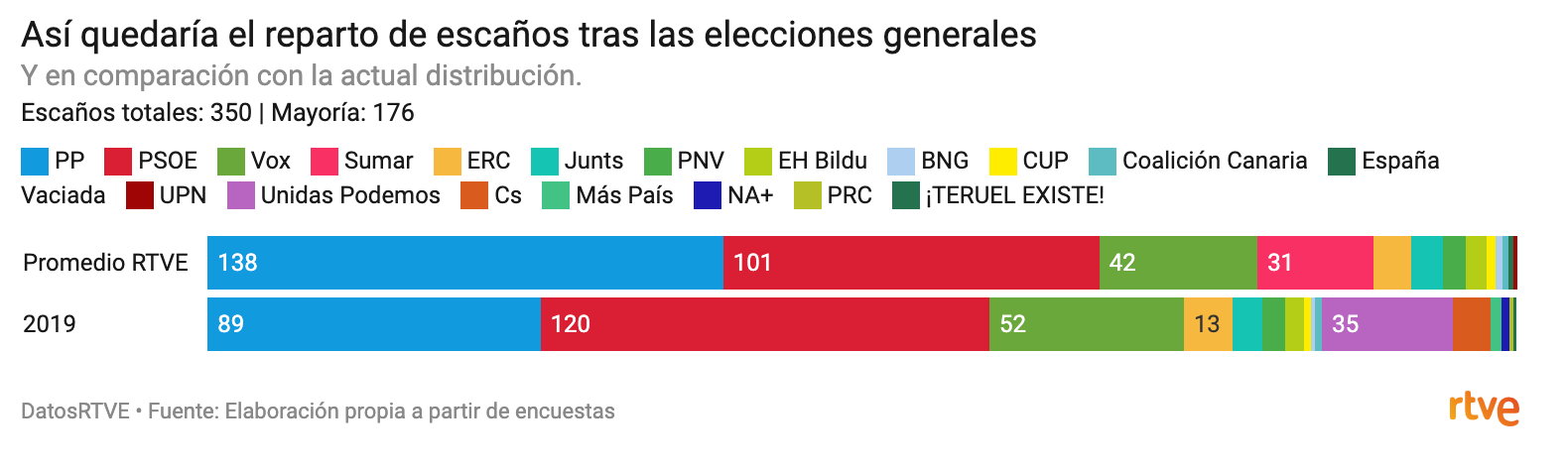
The leader of center-right PP, Alberto Núñez Feijóo, is in the eye of the storm one month away from the general elections. If the polls are to be believed, it’s very likely that the PP will come out on top—but won’t win an absolute majority in Parliament, meaning that it will need far-right party Vox to form a coalition government.
And with that knowledge of how necessary they will be, Vox has been emboldened. Whereas in the past, Vox might have been content with helping the PP keep the PSOE socialists out of government for little in return (as in the Comunidad de Madrid from 2021-3), the far-rightees are letting loose and really making sure that the population know what they stand for this time around. Like Glenn Close in Fatal Attraction, Vox will not be ignored.
With each municipal and regional post-election deal the PP strikes—or fails to strike—with Vox after the 28M elections, the clearer it gets that ruling in coalition with Vox won’t be easy—or quiet.
And we’re not even getting into what happens after the general election. Vox leader Santiago Abascal (who, in photos, bears a passing resemblance to a far right Freddy Mercury) will likely make some big demands, like being Deputy Prime Minister and putting key party members in ministerial roles.
So what exactly is Vox doing that is so Voxxy? Let us count the ways: The municipal PP + Vox coalition in Náquera (Valencia) agreed to remove LGBT flags from public buildings; the PP in the Balearic Islands offered the presidency of the local parliament to a Vox representative who said women were belligerent “because they lack a penis” (more on that below!); and Vox in Madrid set up a giant banner showing a hand tossing symbols of feminism, the 2030 sustainable development goals, the LGBT community, communism and Catalan independence into the garbage (subtle). Outrage from the left surged after each Voxxy outbreak.
These controversies have led Spanish media to almost exclusively focus on Vox this week, with many articles considering what Spain could look like under a PP-Vox rule—and op-eds demanding that Feijóo offer a clear position on where he stands with regards to Vox, something he’s been trying to avoid (because he knows negotiations will be migraine-inducing enough already).
Meanwhile, in Extremadura, it's a full blown war between the PP and Vox.
Following the Valencian express coalition we covered last week, we travel to the other side of the country, Extremadura, where unfriendly relations between PP and Vox show Feijóo has some tough times ahead if he wins the general elections and needs to form a coalition with Abascal.
The PSOE was the most voted party in Extremadura with 39.9% of the votes in the May 28 elections. However, the PP came in a close second with 38.84%, and with Vox, which got 8.12%, could form a coalition government that would make PP leader María Guardiola governor of the region.
But a war exploded between the two—and may lead to repeat elections.
Guardiola warned before the elections that she had no intention of governing with Vox. After May 28, when it became clear she would need their aid to be named president of the community, she went as far as to offer them the presidency of the local parliament, but not any place in the government. Vox refused it—they wanted to run ministries—and Vox bigwig Jorge Buxadé traveled to Mérida, Extremadura’s capital, to apply pressure.
It didn’t work. On Tuesday, Guardiola offered a strong rebuttal of Vox (see video above) saying she couldn’t form a coalition government with a party that “denies gender violence, dehumanizes immigrants, and set up a banner that shows someone throwing the LGBT flag in the trash”. She concluded: “If we need to have a new election, we will”. Clear enough.
At the same time, Feijóo criticized Buxadé for showing up in Mérida, saying that he didn’t agree with national leaders “attempting to close deals” on a regional level. However, when asked about how the PP could justify having opposing strategies in different autonomous communities, he argued that it wasn’t about ideology but about math: Vox got a lower percent of the vote in Extremadura than in Valencia, so their demands there were “disproportionate”.
This statement could pose a problem for Feijóo, though, as polls show that in national elections Vox could end up with results similar to those in Valencia (with Vox polling around 12%), where a deal was reached quickly between the parties.
What does this mean? New elections could be coming to Extremadura. And things are not much different in Murcia, where the PP needs the support of at least two Vox deputies. Problem is, the PP in Murcia have left Vox out of the Parliament's board, and also declined to include them in the regional government. The PP there has said it won’t hold new elections and is urging Vox not to block the reelection of Fernando López Miras as president of the community. But new elections may have to happen.
The left were also up in arms in the Balearic Islands. There, the PP was the most voted political party, with 35.83% of the vote (25 seats), and Vox did surprisingly well with 13.90% (8 seats). Since 30 seats are needed to govern, a deal between both parties was expected to form a coalition government. So the PP’s Marga Prohens, who expects the coalition to vote her president of the Balearic government next week, decided to offer the presidency of the local parliament to Gabriel Le Senne, who as it turns out is, well, the whole VOX enchilada.
The headline on El País Tuesday pretty much said it all: “PP surrenders presidency of the Balearic Parliament to a xenophobic, climate change-denier from Vox”. And that’s not all. Le Senne has also made some pretty spicy comments in the past against the LGBT community, has questioned the seriousness of gender violence and the effectiveness of COVID-19 vaccines and is against abortion and euthanasia.
Oh, and he has also said this:

In case your Spanish is a little rusty, he said: “This is why women are more belligerent, because they lack a penis”. He sounds like a lovely guy. (It bears noting that he was responding to a since-removed tweet from a suspended account, so we don’t know the context. But still…)
As he tries to fight up the polls, current PSOE Prime Minster Pedro Sánchez is trying to make political hay out of statements like these. He’s making the media rounds with one-on-one interviews with friendly outlets (El País, La Sexta) in which he repeatedly warns of the rising threat of the far-right, but puts most of the focus on the PP and how "dangerous it would be if it were to adopt Vox’s politics as its own.” It is the strategy across the left’s political spectrum—criticize Vox, yes, but zero in on Núñez Feijóo and how he may be considering working with the far-right.
Doubts remain about whether this will be too little, too late. Antonio Barroso of political risk consultancy Teneo wrote this week; “Sanchez's bet that the PP-Vox relationship would help mobilize left-wing voters does not seem to be paying off for now, though any potential controversies generated by Vox in the coming weeks might still lead to a last-minute reactivation of support for left-wing parties.”
🔔 A Message From Our Sponsor

Secret Kingdoms is your English bookstore in Madrid. It specializes in Spanish history and literature, contemporary and classic novels, books for children and young adults of all ages, history and historical fiction, thrillers, science fiction, fantasy, poetry, biographies and much more.
Located on Calle de Moratín 7 — a few blocks away from the Prado Museum — and with over 20,000 new and used books, Secret Kingdoms has something for everyone.
Find out more at www.thesecretkingdoms.com
💬 Five things to discuss at dinner parties this week:
1. 🏝️ Build it and they will come tear it down
It sounded like a great idea (did it?)—build a luxury resort on an island near Cáceres, in Extremadura, complete with 185 villas, a 4-star hotel (c’mon, aim a little higher fellas) and a golf course, right in the middle of the Valdecañas reservoir in a special bird protection zone. What could be more beautiful, right?
The developers loved the idea (natch) as did Madrid high society: José María Aznar Botella (ex-PM Aznar’s son) and Beltrán Gómez-Acebo (a cousin of King Felipe VI) were among those who bought houses. Even the regional Extremadura government approved it in 2007, declaring it a Proyecto de Interés Regional (PIR) so it could be built in a nature reserve.
But then there came the legal battles—16 years of legal battles, to be specific—as the environmental group Ecologistas en Acción sued to stop the project because, well, it was pretty undeniably right in the middle of the Red Natura 2000 and had been declared a Zona de Especial Protección de Aves (ZEPA).
The lawsuits went on and on (did we mention 16 years?) until Spain’s Supreme Court declared in 2022 that the ecologists were in the right, the PIR was illegal, and the whole damn “Marbella extremeña” thing needed to be torn down. The issue? A whole bunch of it has been built—and is being used.
Want a timeline? Here’s a timeline.
Now the Constitutional Court has granted a temporary injunction to pause the demolition—until it considers the appeals and gives a final final final ruling (on the sort of logical theory that if it let the demolition happen and then ruled to stop it afterwards it would be sorta expensive and stuff).
That could take a year, or more. Justice isn’t exactly fast in Spain (did we mention 16 years?)
And like always the final ruling may all come down to politics. In the 6-5 vote to pause the demolition, the five against were on the progressive side.
For now, the people who live in Marina Isla Valdecañas are cranky. “It was a dump [before],” one homeowner says, while another local adds, “There are more birds than ever, the storks never left and now there are many more; It is an orchard when before there were only four eucalyptus trees".
The birds had no comment.
2.🎙️ That Pedro Sánchez radio interview on Onda Cero
Everyone with a radio (an archaic device from the past century that broadcasts podcasts but, like, live) tuned into the Onda Cero radio station on Monday morning to listen to what would be one of the highlights of the week: a one-hour interview of Prime Minister Pedro Sánchez by award-winning journalist Carlos Alsina.
Onda Cero is the third largest talk radio station in Spain with almost 2 million listeners, and this was the first radio interview Sánchez was doing since he announced snap elections. It was also the first time he sat for an interview with Alsina in four years, so it was bound to be talked about.
Alsina pulled no punches, with his first question for Sánchez being “Mr. President, why have you lied to us so much?” This referred to some of Sánchez’s unfulfilled promises, like pushing a legal reform to prevent the government from appointing judges to the Constitutional Court (he appointed his Minister of Justice, Juan Carlos Campo, to that position) or saying that a politician could not grant pardons to other politicians (and then granting pardons to Catalan separatists).
Sánchez acknowledged that he’s had “political changes of position on certain state matters, such as the Catalan issue, because “he has had to make very difficult and complex decisions," but at the same time argued that “thanks to those decisions, the situation in Catalonia has changed radically.”
Then Sánchez was asked about his alliance with far-left Podemos, which allowed him to form his coalition government, and Equality Minister Irene Montero, who’s “Only Yes Means Yes” law fiasco seriously undermined his administration.
He admitted “disagreements” with Montero and regretted the unintended consequences of the law, which led judges to reduce the sentences of (and in some cases release) people convicted of sexual assault. "I personally take responsibility for that mistake. I apologized to the victims of sexual assault, and I rectified," he said, adding that he tried to reason with Montero to change the law.
Sánchez even said that he has male friends who have “felt uncomfortable at times” with some of Montero’s speeches because they sounded “exclusionary”, so he supports “thinking and interpreting feminism as an inclusive social movement”.
Alsina also asked Sánchez whether he would agree with Feijóo on letting the most voted party govern if they fall short of an absolute majority after the 23J elections—which would allow the PP to govern without Vox—but the PM avoided giving a direct answer (as politicians do). Sánchez just responded that he’s “running to win”.
3. 😐 And you thought your workplace was the worst
The merely repetitive and tiresome job of working in a call center turned into a nightmare last week when a 57-year-old worker in Madrileño neighborhood of San Blas had a heart attack and died in her cubicle—and several of her 70 co-workers reportedly continued handling calls for an Iberdrola campaign at their own desks for over two hours, with her covered corpse still in the office.
The tragic events happened around 12:30 p.m. last Tuesday, June 13, in an office of the Madrid-based customer service multinational Konecta, when a 15-year-veteran named Inma raised her hand and asked for help—not for IT issues, but because of a health emergency—a heart attack.
Samur sent six ambulances and other health vehicles to the site between 12:43-12:50 p.m., but nothing could be done to save Inma.
Inma’s covered body remained on the floor, guarded by the police while they waited for a judge to arrive.
What exactly happened next is unclear, with Konecta, the CGT union that represents the works, and even the workers among themselves offering conflicting Rashomon-like retellings of the events. This is what we believe to be true:
Inma’s nearby co-workers left the area, but some further away continued to work.
Konecta’s head of occupational risk prevention arrived around 2 p.m. and told everyone to leave in an orderly fashion.
But when the CGT union’s head of occupational risk prevention arrived at 3:10 p.m, he says he found four workers still fielding calls at their cubicles.
The fog of war is thickest between Inma’s death and the arrival of the two risk prevention heads. According to three CGT representatives, when one confused telemarketer asked to go home, a supervisor said to continue because the “work was essential.”
“She’s lying on the floor and we are taking calls,” Antena 3 quoted workers as saying in a WhatsApp chat. “Yes, they’re telling us to keep taking them,"
Four Konecta workers who spoke to El País, on the other hand, said there was no general call from the company to continue working.
It appears that some telemarketers left immediately—but that others kept working out of telemarketing’s hamster-wheel habit (where calls come every few seconds) and a few were told to stay on, at least until the Konecta boss arrived, and because of that the CGT was (understandably) unhappy.
Most importantly, Inma QEPD.
4. 👨🏼💼Did that nice elderly gentleman just tell us to screw ourselves?
Barcelona mayoral race was a nailbiter. Wait, that’s not true. The process to name the Barcelona mayor—in Spain, a kind of city prime minister—after the election was a nailbiter, with last-minute twists and backstabs. And an angry elderly gent.
The BCN mayor’s election on 23M basically ended with a three-way tie. Xavier Trias, a right-leaning representative of the separatist Junts party came in first with 11 seats on the city council; the representative of the Catalan socialist PSC franchise Jaume Colboni got 10; and the local Podemos-ish candidate (and last mayor) Ada Colau, of En Comú Podem, came in third with 9.
The issue? To lead the 41-seat city council as mayor, you either need to construct a majority (21) to vote for you or, otherwise, the leading vote-getter (in this case, the previously mentioned Trias, age 76) gets the mayoralty by default.
The issue Part 2? Neither Colboni nor Colau would support Trias. Next: Colboni and Colau, who’d run the city before, didn’t have enough votes to get to 21—and no one else would support a government if both were in it. So there seemed to be no other option than Trias as mayor again (he’d been the big man from 2011-15).
So all done, right? Wrong! Yup…fun, dicey, last-minute wrong.
Trias put together a minority government with the left-leaning pro-independence party ERC (adding 5 more seats) and sort of chilled out. Happy times!
Then an hour before the mayoral inauguration was to start, at 5 p.m. Saturday, Colau’s party made a surprise announcement: They would support Colboni of the PSC for mayor—without forming a colaition.
This led the center-right PP to say it would vote for the PSC socialists too—as long as they didn’t let those nasty En Comú Podem lefties into government. Apparently they received some nod in that direction (at least enough to claim they’d been duped if it comes to pass).
Why? With the 23J elections coming up, being the national party responsible for pro-separatist parties leading Spains’ second-largest city may have seemed like too much of a national vote-destroyer to contemplate.
Then came the cranky bits. Trias was ticked off. Like, as epically pissed off as a straight-laced member of the local aristocracy (especially one who’s seeing his last chance at being mayor melt away) can be. “Y’all can go screw yourselves,” [Que els bombin a tots] he said, as he tossed a glass of bourbon on Colboni’s face and backhanded the new PSC mayor (ok, we made up the bit about the bourbon and the slap, but the words are his).
But no, do go on! Trias made ye olde conspiratorial claim that a back-room deal had been struck against him—which inevitably became for Catalan pro-indy media and politicians a smoky deal “made in Madrid.” Even Colboni looked nauseous before his inauguration (where apparently almost everyone booed him). Happy times all around!
Now, will Barcelona be ungovernable for the next few years? Really, could be.
5.😷 Goodbye, face masks
Face masks. Remember them? As a fashion item, they are definitely passé. And while most us have burned ours hoping we’d never have to wear them again, we still keep a few hidden under the bathroom sink in case we need to visit a health center or a pharmacy, the only two places in Spain where it is still mandatory to wear one.
That could change very soon, as Health Minister José Miñones said that he would convene an “Interterritorial Council” (a meeting of the regional health authorities) on Friday to discuss eliminating this (ed note: really annoying) requirement.
Regions such as Madrid, Cataluña, Valencia and Extremadura, have been requesting the end of the whole mask pantomime for months, and now the Ministry of Health seems determined to end the requirement to use masks in pharmacies and healthcare centers.
Spain has been a bit of an outlier on the issue—and is only becoming more of one.

So expect Face Freedom this Friday. Even the health minister noted that already “most people forget about wearing masks in pharmacies”. Which is 100% true because let’s face it, we never do. (Notice that ‘face it’ joke? Funny, right? Or…not.)
🙏 Before you go, please remember to share this newsletter with your friends on social media. The more we grow, the more information we’ll be able to offer each week.
We’ll be back next week with more.