



Madrid | Issue #133
🇪🇸 The Bubble is Spain's #1 English-language, best-selling newsletter. We offer paid subscriptions, and we’d be thrilled to have your support!
🚨 Customize your subscription! You can personalize your Bubble experience so you only get the emails you want—and never the ones you don’t. Click here to learn how.
📺 Sponsorship opportunities. Want to get your brand in front of our engaged and influential audience of professionals, creatives, and government workers? We’re now offering a variety of ways to do so. Click here to find out how and book a spot.
We still don’t know what really happened
🛤️ A deadly train collision in Andalucía leaves Spain in mourning

Spain faced a tragedy this week that it hoped never to relive. Less than 13 years after Spain watched, forlorn, as 79 passengers died in a high-speed train derailment in Galicia, the country is again mourning dozens of victims. On Sunday night, a speeding southbound train slammed into a northbound train whose last two cars had derailed and slid across the tracks just outside the Andalusian town of Adamuz.
This new tragedy is brutal. Shortly after the crash around 7:45 p.m., reports began to filter in of a ‘Dantesque’ scene at the crash site, with bodies torn in two, survivors wandering aimlessly ‘like zombies’, and others screaming from inside the wreckage. The two high-speed trains together had been carrying close to 500 people.
The slow drip of bad news. Early reports pegged the death toll at 19, but the number climbed through the night and into the following days as emergency workers cut open mangled train cars to recover the dead. Families searched hospitals for missing relatives, filling the news vacuum with dread.
Each tale was uniquely devastating. Six-year-old Cristina, who’d traveled with her family to Madrid to see El Rey León as a King’s Day gift, was the only survivor, losing her mother, father, brother, and cousin. Another family from Lepe (Huelva), whose 27-year-old daughter was in the first row of the speeding southbound train, refused to believe she was dead even after their city hall sent condolences. As of last night, there were 43 confirmed deaths, and the Guardia Civil said two bodies remained in the wreckage.
But what caused the crash? Unlike the crash in Galicia 13 years ago, which was immediately blamed on the professional recklessness of a train engineer driving at twice the posted limit, the cause of Sunday’s crash was not obvious. Transport Minister Óscar Puente spoke for many when he defined the crash as “strange, odd, and difficult to explain.”
Some causes were quickly ruled out. Like human error. The crash occurred on a flat straightaway, at speeds well below the 250 km/h limit, and the drivers had no time to react. And the gear looked good: The track had just undergone a €700m renovation, and the derailed Iryo train was less than four years old and inspected days earlier.
But there are clues. Investigators soon identified a gap in the track where the rails had separated. According to El Español, the joint appeared to have been welded manually, a less secure method; Reuters reported that the gap may have existed for some time and widened gradually. Transport Minister Óscar Puente cautioned that “no technician is yet able to say whether [the gap] is a cause or a consequence” of the derailment.
And then there’s the bogie. Several days after the crash, one of the Iryo train’s bogies — the wheel assemblies that connect a train to the track — was discovered in a nearby creek. (Whether it was found by a wandering New York Times photographer or Guardia Civil investigators is, um, unclear.) Its presence far from the wreck raises a disturbing question: did it fly off in the crash, or cause the derailment by detaching at high speed?
A working hypothesis. Investigators are far from declaring a cause, but the gap in the track, the missing bogie, and reports of wheel gouges on earlier trains point to a possibility: that the gap widened over time as trains passed, scratching their wheels, until it caught the final train’s bogie hard enough to derail the train — and send the bogie flying. But let’s be clear: this remains unproven.
Adults in the room. In the hours after the crash, Spanish politics did something it almost never does anymore: it shut up. Parliament, the Senate, regional assemblies, and party headquarters all observed minutes of silence. For a country locked in permanent trench warfare, it briefly felt like a ceasefire.
Prime Minister Pedro Sánchez scrapped his Monday schedule, flew to Córdoba, and declared three days of national mourning.
PP leader Alberto Núñez Feijóo echoed the tone, telling Sánchez by WhatsApp to postpone a long-awaited meeting (their first in 10 months) because “nothing was more urgent now than attending to the victims.”
The only major leader who broke the unofficial truce? Far-right Vox’s Santiago Abascal, who mixed condolences with an attack against the government. Still, he eased off a bit. 🤷
But as shock gave way to anger and early technical details leaked — the gap in the rails, the missing bogie, questions about inspections — politicians from Vox and the PP began pointing fingers, especially at Puente. The government responded by calling Vox leader Santiago Abascal “vile and inhuman.”
Well, it was nice while it lasted. The ceasefire lasted about 48 hours.
More news below. 👇👇
🔔 But first, check out our sponsor — Bureaucracy.es

We’ve teamed up with our friends at Bureaucracy.es to bring you more resources about immigration and life in Spain. Check out our guides on how to get a Spanish Digital Nomad Visa or Non-Lucrative Visa.
If you’d like their help with the paperwork to apply for these visas, or need someone to guide you through the Spanish citizenship application process, you can hire them using this link (and, in the spirit of full transparency with our subscribers, The Bubble will receive a small commission).
💬 Five things to discuss at dinner parties
1. 🙌 Catalonia’s president is not dead! (But he’s sick with something weird)
The news out of Catalonia Saturday was the kind of stuff that makes you think the zombie apocalypse has begun. Regional president Salvador Illa was whisked by ambulance to the emergency room of Barcelona’s Vall d’Hebron Hospital, suffering severe pain and loss of strength in his legs.
He had tried to run in the morning, then participated in an institutional event, but the pain got so bad he couldn’t go on. No one knew the cause. All the doctors would say was that it was not a stroke. Our first thought: He’s going to start biting people. 🧟
But Illa didn’t die and come back to life (or bite anyone, thankfully), so we — and Spain’s medical establishment — had to look for a serious diagnosis.
48 hours passed. Initial tests ruled out “serious” pathologies, like a stroke, a tumor, or a vascular problem. But as of early Monday, hospital officials were still only talking vaguely about an “inflammatory process.” Which is…sorta helpful?
Then came the diagnosis. On Monday evening, doctors said tests showed Illa suffered an osteomyelitis of the pubic symphysis caused by Streptococcus dysgalactiae. In simple English, that means a bacterial infection of the joint that connects the left and right pubic bones at the front of the pelvis.
But really, it’s grosser than that. We looked this up, and the Cleveland Clinic says osteomyelitis is a serious infection where bacteria invade your bone marrow 😱, often spreading through your bloodstream from a wound on your skin.
And Streptococcus dysgalactiae! It turns out that Battlestrep Galactica (our nickname) can cause everything from skin infections to necrotizing fasciitis — aka flesh-eating disease. So maybe Illa isn’t a zombie…but has a zombie in him! 🧟
The good news? Illa is responding well to treatment (lots of antibiotics) for what his doctors call “a very rare disease”. His fever is gone, his pain has eased, and he’s left the ICU — though he is expected to remain in the hospital for at least two weeks to fully recover. His deputy Albert Dalmau will handle his functions in the meantime.
We’re glad to hear his prognosis is good. But we wouldn’t be surprised if he bit someone.
2. 👸🏻 Irene de Grecia, Queen Sofia’s baby sister, dies at 83
Irene de Grecia (Irene of Greece), the inseparable sister of Queen Sofía (mother of the current King of Spain, Felipe VI), died in Madrid last week. She was 83.
Wait… who? If her name doesn’t ring immediate bells, it should. She was one of the most singular royals of Europe.
She was the daughter, sister, and aunt of kings — and yet chose a quiet life in Madrid, far from palaces or protocol.
To her Borbón grandchildren, she wasn’t “Her Royal Highness,” but simply Aunt Pecu — short for Peculiar, a nickname earned by being, yes, delightfully eccentric.
Aunt Pecu’s health had deteriorated sharply in recent months, and Queen Sofía cancelled her entire agenda to remain by her sister’s side at Zarzuela Palace.
Farewell in Madrid. Her funeral rites began in Madrid, where she had lived since the 1980s. A private funerary chapel was set up inside the Zarzuela palace (which is pretty rare), followed by a service on Saturday at the Iglesia Ortodoxa Griega de San Andrés y San Demetrio.
Queen Sofía looked visibly devastated. Her bond with Irene was legendary: the sisters shared homes, summers in Mallorca, holidays around the world, and a companionship that lasted more than 80 years.
Who showed up (and who didn’t). The Madrid funeral brought together almost the entire Spanish royal family… except, notably, Juan Carlos I, whose doctors advised him not to travel to either ceremony because of the physical strain.
His absence was widely noted. It would have been his first reunion in years with his granddaughters Leonor and Sofía, who did attend to support their grandmother.
Final goodbye in Athens. On Sunday, Irene’s body was flown to Greece for her public farewell. The Metropolitan Cathedral of Athens held a packed funeral on Monday, after a morning wake that allowed ordinary Athenians to pay their respects.
The coffin, draped in the Greek flag and surrounded by wildflowers from the Aegean, was carried in by members of the Greek royal family.
The Spanish royals occupied the front pews. Queen Sofía, the infantas, several grandchildren, and later King Felipe VI and Queen Letizia, who flew in briefly despite the unfolding rail tragedy in Córdoba.
As Irene wished, she was buried in the Royal Cemetery of Tatoi, next to her parents and her brother Constantino.
A life stranger than Netflix fiction. Irene de Grecia lived one of the most unusual lives in European royalty.
Born in exile in South Africa during WWII, she grew up between Egypt, Greece, India, and Italy, trained as a pianist, studied archaeology, embraced Hindu spirituality, practiced philanthropy, fought for animal rights, and was famously fascinated by ufology and the paranormal.
She never married, never took on official duties, and never chased titles; she simply chose a life of curiosity, independence, and family.
In both Madrid and Athens, this week felt like the end of a chapter of modern royal history, one written by a peculiar royal who never quite behaved like one.
3. ✝️ Attention, sinners! The Pope is coming to the Bernabéu this summer

Have you noticed church ladies looking unusually joyful these last few days? Here’s why: the Pope is coming to Spain, and the Vatican is quietly preparing one of the most ambitious papal trips in recent memory, including a massive stadium event at the Santiago Bernabéu. Popealooza, here we go.
The visit is slated for early June, with Madrid as the grand opener (apparently from June 6-9), followed by Barcelona and the Canary Islands, before León XIV flies back to Rome around June 12.
The schedule isn’t fully confirmed (the Holy See moves at Vatican speed), but here’s what it’s looking like:
Madrid: reception at Barajas, meeting with the King and Queen at Zarzuela Palace, a pastoral stop at Cáritas, an academic event in El Escorial… and the headline act: a giant youth vigil at the Bernabéu. The date being floated for the stadium is June 6 or 7, aligned with the Feast of Corpus Christi, which tracks: Spain is Catholic, Corpus is huge, and football stadiums already know how to move 80,000 humans through metal detectors.
Barcelona: the trip will orbit the Sagrada Familia (obvi), coinciding with the centenary of Gaudí’s death and the inauguration of the Torre de Jesucristo, the basilica’s tallest tower (finally!). Expect heavy symbolism, lots of cameras, and probably some political drama.
Canary Islands: the Pope wants to visit frontline migration hubs in person; something Pope Francis said he wanted to do before dying, so the trip may include meetings with migrants and local pastoral workers.
Why this matters (even if you’re a heathen not Catholic). Spain may feel increasingly secular, but it’s still the world’s fourth-largest Catholic country and one of the Vatican’s biggest historical arenas.
The last time a pope did an official visit here was Benedict XVI in 2011 for World Youth Day, when Madrid briefly turned into a Catholic Coachella.
And if you’re old enough, you might remember John Paul II filling the Bernabéu in 1982 in a Cold War-era mega-mass.
So yeah, in a country where football is a religion, this is as on-brand as it gets.
Logistically, the whole visit will probably be a nightmare. But symbolically, it puts Spain back on the Vatican’s top tier after a 15-year absence.
We’ll update once Rome makes it official.
4. 🏘️ Ever wonder why it’s so hard to crack down on illegal Airbnbs?

 Tiktok failed to load.
Enable 3rd party cookies or use another browser
The Spanish government has made a lot of noise about how it’s fining the hell out of Airbnb for publishing unlicensed listings, and Barcelona has gone nuclear, pledging to ban all tourist apartment rentals by 2028. Now, we’re not entirely convinced that banishing tourist rentals will magically solve Spain’s urban housing shortage, but the reality is we don’t know if it would work…because illegal rentals keep multiplying like cockroaches with law degrees.
Don’t believe us? Let us tell you a story from this week.
The Italians are coming. Allegedly. In Barcelona’s Eixample, a group of enterprising (allegedly Italian) tenants quietly built an entire secret bathroom inside a rented flat — no permits, no shame — to transform ordinary bedrooms into €150-a-night “luxury suites.” Doors were sealed, new ones hacked open, and voilà: a boutique hotel hidden inside a perfectly respectable apartment.
Wait, that’s my house. The owner only figured it out after spotting her own floors and ceilings in Airbnb photos… plus a bathroom that, inconveniently, did not exist when she bought the place. She booked the listing herself and found the surprise loo right where the washing machine used to live. (Barcelona: city of Gaudí, butifarra, and clandestine plumbing.) Oh, and when she called the tenants on what they’d done? They threatened her with legal action. In Italy. And Spain.
And this, inspectors say, is not their first rodeo. The same kind of networks operate high-end flats across the city — Eixample, Diagonal, Passeig de Gràcia — often renting them under the pretext of housing “athletes” or “employees” of vaguely defined sports clubs. When caught, they stop paying rent, lawyer up, claim the protections offered to so-called “vulnerable” tenants, and drag evictions out for years while the tourists keep rolling in.
New twist? AI. Listings now use AI-generated images so inspectors can’t use views from the windows to identify the address. Guests are choreographed like SEAL Team 6: arrive by taxi, text five minutes before, never loiter in the portal with a suitcase. No wandering tourists, no awkward questions from neighbors, no evidence. Just money. 🤑
Shouldn’t they be scared of The Man? Naaaah. The fines are €60,000 a pop, but the profits are way higher. Which is why City Hall, lawyers, and inspectors are all saying that this isn’t a housing violation problem anymore, but organized, professional fraud dressed like a realtor.
Apartur, the lobby for legal tourist apartments, of all people, says that there are more than 3,000 illegal room rentals in Barcelona alone. Cockroaches. With law degrees. That’s why illegal Airbnbs are so hard to stamp out.
5.👺 Spain got a new duende in town — and it's got huge teeth
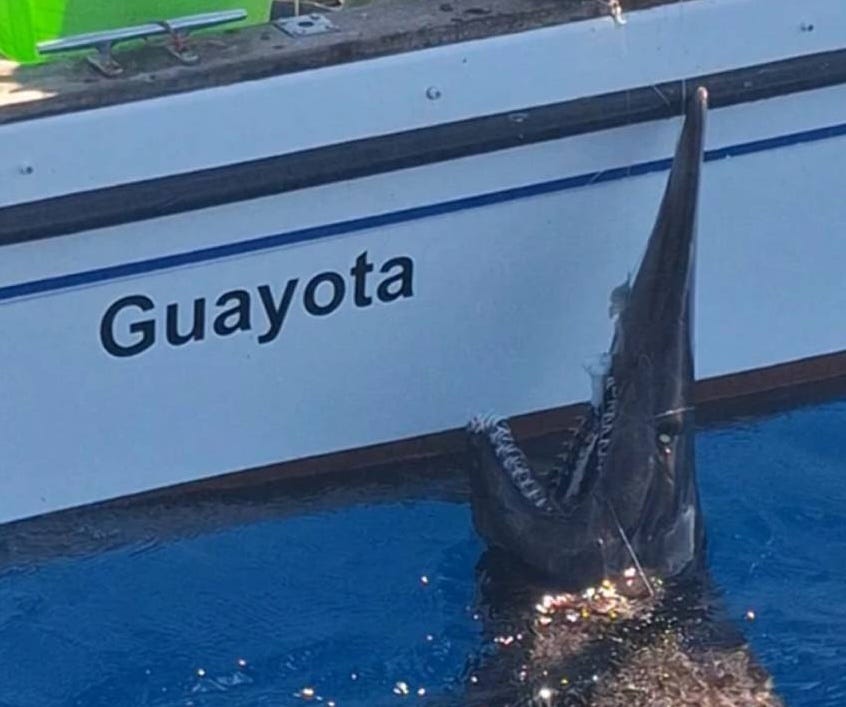
You, of course, know that in Spain, duende has two meanings. One is folkloric: a mischievous goblin, elf, or general agent of household chaos. The other is sacred. In art (especially flamenco) it’s that dark, electric force that turns performance into something like possession and takes us to terrifying places we might otherwise avoid. As Spain’s über-poet Federico García Lorca put it, “The duende doesn’t show up unless death is in the room.”
Well. Spain now has a third kind of duende, and it looks like it’s also here for death: the tiburón duende. Yes. The goblin shark.
Researchers at the Universidad de La Laguna (Tenerife) announced this week that they had documented the first live goblin shark ever recorded near the Canary Islands—and only the second confirmed sighting in the entire Macaronesian region (the North Atlantic near Africa).
The shark, a 2.5-meter female, was caught accidentally (the luck!) during a recreational fishing trip off the coast of Gran Canaria, nearly 10 kilometers offshore and some 900 meters below the surface. She was caught on rod and reel using mackerel and squid as bait, and after being photographed and filmed (because obviously), she was released alive.
Goblin sharks are deep-sea oddities, often described as “living fossils” and instantly recognizable by their flattened, blade-like snouts and their party trick: jaws that shoot forward like something designed by H.R. Giger after too much pacharán. They also have tiny eyes, flabby bodies, and an overall groove that suggests evolution briefly considered adding every horror and then said, “Hell, why not?”
Fewer than 250 goblin sharks have ever been documented worldwide. They live scattered across tropical and temperate oceans at depths of 250 to 1,500 meters, which helps explain why most humans will never meet one. In the northeastern Atlantic, sightings have been limited to places like Galicia, Madeira, Morocco, and Portugal — making this Canary Islands appearance a big deal. (National Geographic calls it the “rarest shark in the world.”)
Good news, really! The finding, published in the scientific journal Thalassas, also highlights something Spain doesn’t brag about as much as it should: the waters around the Canaries are unusually well preserved. Bottom trawling has been banned since the 1980s, and targeted fishing for deep-water sharks is limited, turning the area into a kind of accidental sanctuary for marine weirdos.
On timing. We’re not quite sure why, but it took 18 months from when the shark was accidentally caught — in May 2024 — to when the university published the news about it. You know if a tech startup had caught this duende, he woulda been on TikTok and the basis of a posing trend 30 seconds later.
🙏 Once again, please remember to share this newsletter with your friends on social media. The more we grow, the more information we’ll be able to offer each week.
Amen. It's truly awful, in every possible way.
Let us respect and send love to all affected by this horrible tragedy. My heart is broken in many pieces. It is more than news, it is a national calamity worthy of many days of luto.